
Rethinking efficiency in monogastric systems

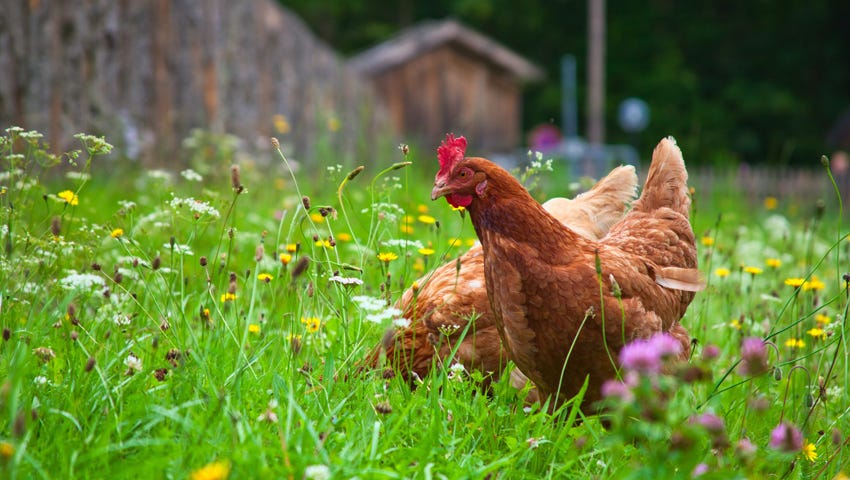
Much of the conversation about sustainable livestock systems has focussed on ruminants, but monogastrics: pigs, laying hens and broilers, are more challenging.
Monogastrics are more deeply embedded in industrial production, more exposed to welfare compromise, and more dependent on feed that competes directly with human food.
Our latest Farm Gate conversation about the EU Horizon 2020 Pathways project brought together people with very different perspectives: Dr Jenny Yngvesson (Swedish University of Agricultural Sciences) is a welfare scientist studying what indicators can tell us about how animals are actually farmed — Dr Catherine Pfeifer (FiBL Switzerland Agri-Food Systems Group) is a systems modeller working through the trade-offs between food security and environmental limits — and Dr Lizzie Rowe (Leaf and Feather) is a micro-farmer who has built a working alternative from the ground up.
Measuring what matters
For Dr Jenny Yngvesson, the starting point for the Pathways monogastric work was deceptively practical: how do you actually measure animal welfare across an entire continent?
The project developed what Yngvesson calls iceberg indicators — signals that reveal a great deal about welfare with relatively little investigative effort. Critically, these needed to be measurable at the point of rearing, during transport, and at slaughter, and they needed to work across the enormous variation in farming systems found across EU member states.
The challenge, as Dr Catherine Pfeifer acknowledged, is that welfare is fundamentally observational. You cannot reduce it to a number in a spreadsheet in the way you can a carbon figure or a feed conversion ratio. This made welfare one of the harder variables to incorporate into the Pathways modelling, even as it remained central to the ethical framing of every scenario.
Efficiency First
The Pathways project developed five distinct scenarios for the future of European livestock, and then modelled projected change through three of them: Efficiency First, High Animal Welfare, and Feed No Food.
For monogastrics, Pfeifer’s work on the Efficiency First scenario provides the sharpest illustration of where the industrial logic leads if followed to its conclusion.
The approach was to identify the most efficient production system in Europe and model what would happen if it were applied universally. For pigs, that meant Denmark — a system producing 34 piglets per sow per year, compared to just 12 in Italy, where animals are managed differently to meet the weight and quality requirements of products like Parma ham. The scale of that gap, Pfeifer noted, reflects not just management differences but Denmark’s role as a piglet exporter to the rest of Europe, effectively specialising at continental scale.
Beyond selecting best-in-class systems, some models within the project also incorporated potential genetic gains — continued selective breeding for higher piglet numbers and better feed conversion efficiency. Pfeifer expressed scepticism about where that road leads. The plateau argument is real: in broiler chickens, genetics have already pushed productivity to a point where leg problems and metabolic disorders have become endemic. Adding another leg, as she put it, is not an option.
Feed No Food
The Feed No Food scenario rests on a compelling circular principle: if monogastrics are fed only on material that humans cannot or would not eat, the competition between animal and human food chains disappears. Byproducts, food waste, crop residues — these become the feed base, and the animals become converters of otherwise lost nutrition.
The problem, as Pfeifer explained with characteristic directness, is that the premise reveals its own limitation. We do not actually produce that much direct waste — and that is mostly good news. A food system generating less waste is a more efficient food system. But it also means there is a finite ceiling on how many animals can be supported this way, and that ceiling is considerably lower than current production levels.
The result is a scenario that requires substantially fewer pigs, laying hens and broilers. That is bad news for anyone expecting consumption patterns to remain unchanged. But Pfeifer reframed it: those fewer animals could be kept in genuinely high-welfare conditions, fed in ways that align with their natural behaviours, with pollution pressures low enough to become almost incidental. The welfare gain per animal could be transformative precisely because the numbers are small enough to manage with real attention to each individual.
Yngvesson reinforced this from a welfare science perspective. Both pigs and poultry have a fundamental need to forage — to search for food rather than consume a processed, ultra-nutritious ration delivered in a trough. Feeding animals on byproducts and residues, presented in ways that require some effort to access, can actually improve welfare outcomes at the same time as reducing the feed competition problem.
Feed No Food in practice
Dr Lizzie Rowe did not set out to exemplify a Pathways scenario. She set out to see whether she could keep animals healthy, happy and productive on a diet built entirely from what others were throwing away.
Five years on, her micro-farm — currently home to around 90 chickens, growing towards a maximum of 300, alongside pigs, bees and mushrooms — suggests the answer is yes.
The feed system is an improvisation of remarkable resourcefulness. Screenings and cleanings from organic grain production — material that fails the specification for human food and was, in one case, being burned by the farmer to prevent weed seeds re-entering fields — form the grain base, purchased at a fraction of the cost of conventional organic feed. Whey from a local cheesemaker, collected free of charge rather than being poured down the drain, goes into a fermented porridge mixed with ground waste beans and wheat. Whole oats are fermented to increase nutrient bioavailability.
And then there are the black soldier fly larvae.
Rowe describes herself as both a chicken farmer and a maggot farmer, and the larvae are central to her system. She runs the complete cycle on farm: flies in cages, eggs collected and hatched, larvae raised in trays stacked inside a repurposed shipping container and fed on spent brewers’ grain from a local brewery. In two weeks, near-invisible hatchlings become two-centimetre grubs dense with protein and beneficial oils. The grubs function like miniature cows — taking a low-value waste stream and concentrating its energy into something nutritionally rich that then feeds the chickens.
The breeds she uses are dual-purpose: neither the hyper-specialised laying hen of commercial systems nor the fast-growing broiler, but animals selected for both egg and meat production. They lay around 200 eggs per year rather than the 270 to 340 achievable in cage or barn systems. Their meat takes 16 weeks to develop rather than 50 to 56 days. It is darker, more flavourful and, Rowe argues, nutritionally richer — a product that needs cooking differently but brings its own character rather than acting as a flavour absorber.
Mortality in her flock is virtually zero.
Rethinking efficiency
The word efficiency runs through the monogastric debate like a fault line. Rowe challenges it directly. Feed conversion ratios measure something real, but they measure it in isolation. Being maximally efficient with inputs that are themselves unsustainable, she argues, is not efficiency in any meaningful sense.
Pfeifer offered a reframing that cuts to the heart of the Pathways findings. If food security is defined as maximising the protein output of the entire food system — not just the animal production subsystem — then systems like Rowe’s score extremely well. They extract protein from waste that would otherwise leave the food chain entirely. The animals that appear inefficient at the individual level are, at the systems level, doing something that the highly efficient Danish pig unit cannot: capturing value from material that would otherwise be lost.
This is the paradox at the centre of the project’s findings. Efficient animals in inefficient systems may produce less food security, not more.
What industrial monogastric farming actually costs
Yngvesson brought the welfare analysis into sharp focus. Farm size, she stressed, does not automatically imply poor welfare — but the combination of scale with the management approaches typically associated with it creates conditions that are very hard to reconcile with animals’ fundamental needs.
For pigs, the challenges are multiple and severe. Confinement in crowded spaces without environmental enrichment produces abnormal behaviours, most strikingly cannibalism, and depression-like states that are increasingly well documented in the scientific literature. Sow stalls restrict a farrowing sow to a space where she cannot turn around during the critical early weeks of her piglets’ lives, disrupting the intricate communication — the 20-second milk letdown signal, the coordination of suckling — on which the survival and development of the litter depends.
And pigs cannot sweat. In a warming climate, this is not a minor detail. Pigs regulate body temperature through wallowing, a behaviour that is effectively impossible in even EU organic systems. Showers can be installed, but they do not satisfy the behavioural drive. When pigs overheat, they stop eating, grow more slowly, and eventually begin to die. Intensive pig farming in a 2C or warmer world faces a fundamental physiological constraint that efficiency metrics cannot solve.
For broilers, the problem is different but equally intractable. Genetic selection for rapid growth has reached what Yngvesson describes as a biological limit. Legs cannot support the breast muscle mass; metabolic systems are overwhelmed. The solution emerging in several European countries — the Netherlands and Norway prominent among them — is a shift to slower-growing breeds with enriched environments, including perches, elevated resting areas and artificial mothers that provide the behavioural synchronisation signals that commercial chicks are currently denied. Norwegian producers report that profitability in slower-growing systems is comparable to or higher than in conventional production.
Then there is the question of mutilation. Tail docking is near-universal in European pig production. Beak trimming affects almost all laying hens. Male piglets are routinely castrated without anaesthesia. These are not incidental features of the system; they are structural requirements of it. As Yngvesson observed, if a production system can only function by routinely mutilating the animals within it, that is a signal that the system has been designed around human and economic requirements at the expense of the animals it contains.
The human cost
Pfeifer introduced a dimension that is often absent from agricultural welfare discussions: the welfare of the people who work in intensive systems.
Covid-19 made this visible in a way that could not be ignored. Slaughterhouses became outbreak sites not because of any failing specific to food production, but because the economic logic of industrial processing had concentrated large numbers of workers in difficult conditions, often housed in poor accommodation provided by their employers.
Her framing was direct: you cannot have happy animals without happy people, and you cannot have happy people doing work that involves the routine, high-speed processing of animals at industrial scale. This is not an argument she found satisfying to make — it was, she said, an exercise in understanding trade-offs, not an endorsement of the system. But the implication is clear: the true cost of efficiency-first monogastric production includes human welfare costs that do not appear in any feed conversion ratio.
Yngvesson provided the scientific grounding: there is robust evidence that staff welfare, job satisfaction and positive attitudes towards production animals correlate with better animal welfare outcomes and higher production efficiency. The relationship runs in both directions. Good working conditions, fair pay and a physical environment that staff find acceptable produce animals that grow better and survive longer. The spiral can be virtuous or destructive.
Avian flu and the risk architecture of scale
The biosecurity argument for industrial production — the idea that biosecurity measures in large, controlled environments protect against disease — came under scrutiny. Yngvesson’s response was measured but pointed. Recent avian influenza outbreaks have demonstrated that even indoor flocks with high biosecurity standards are not reliably protected. When an outbreak occurs in a flock of hundreds of thousands, the consequences cascade rapidly across national and continental production. The disposal of millions of birds is itself an animal welfare crisis, a public health risk and a traumatic event for the workers involved.
The assumed trade-off between small-scale systems and biosecurity risk is therefore not as straightforward as it appears. Scale concentrates risk as well as managing it. A landscape of diverse, smaller flocks may distribute disease risk differently rather than simply amplifying it — though Pfeifer was careful to note that unmanaged urban chicken-keeping, of the kind found in parts of Africa and the Middle East, represents a genuine zoonotic risk that should not be romanticised.
Scaling out, not scaling up
The concept Rowe returned to most insistently was scaling out rather than scaling up. The dominant model of agricultural development has been to make farms larger, more capital-intensive and more productive per unit of labour.
The alternative she describes is a proliferation of small, diverse, low-input operations — many farms doing what she does, rather than her farm growing to the size of an industrial unit.
This requires infrastructure that has been progressively dismantled. Small-scale abattoirs have largely disappeared from the UK. Legislative frameworks built around large-throughput processing facilities make it difficult or impossible for micro-farmers to sell animals slaughtered on-farm, even with professional mobile slaughter services. Peer-to-peer learning networks, direct sales channels and local markets all need rebuilding. Blueprint documentation — the practical knowledge of how to set up a black soldier fly unit in a shipping container, how to integrate dual-purpose breeds into a mixed farming system — needs to be developed and shared.
Rowe is involved in research projects aimed at creating exactly this kind of blueprint. The goal is replicability: systems that other farmers can adopt and adapt, spreading practice without requiring any individual operation to reach a scale that defeats the welfare and ecological purposes the system is designed to serve.
The trade-off society has not yet faced
Pfeifer closed with what is perhaps the most important observation of the conversation: the trade-offs that Pathways has spent five years modelling are not, in the end, scientific questions. They are social and political ones.
The science can tell us what is possible within planetary boundaries. It can tell us what different consumption levels imply for the systems needed to produce them. It can identify where human welfare, animal welfare and environmental limits pull in the same direction and where they diverge.
What it cannot do is decide what level of animal protein consumption is acceptable, whose dietary needs should be prioritised, or what weight to give to animal suffering relative to human affordability. Every food purchase, she noted, is already an implicit answer to these questions. We are already making choices; we are simply not making them explicitly or collectively.
The Pathways scenarios are not prescriptions. They are a map of the territory — showing where different paths lead, what they cost, and what they deliver. The decision about which path to take is one that societies, food systems and policy frameworks have not yet seriously begun to make.
Pathways is a five-year EU Horizon 2020 funded research programme investigating sustainable livestock systems across Europe. This is the fifth in a series of Farm Gate podcast programmes exploring its findings.
Listen to the conversation below.