
What does "efficiency" mean for the future of ruminants?

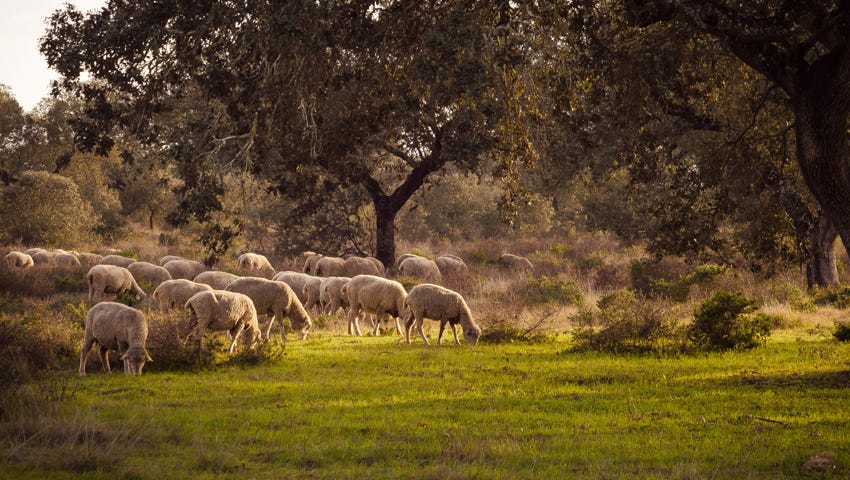
For a generation, the dominant narrative around ruminant agriculture has been shaped by emissions reduction targets and public concern about livestock’s contribution to climate change. That pressure has driven intensification across much of Europe — and with it, a particular definition of efficiency: more output, fewer inputs, lower emissions per kilogram of product. But as knowledge of ecosystem services, carbon sequestration and biodiversity has deepened, a counter-movement has gathered — one that recognises the intrinsic value of well-managed, pasture-based systems.
That deeper understanding has led many farmers and researchers to question not just the direction of travel, but the very meaning of “efficiency” in modern agricultural systems. What are we optimising for? And for whom?
I spoke with Simon Moakes, research fellow at Aberystwyth University in Wales, Dr David Yáñez-Ruiz, research professor at the Spanish National Research Council, and Sara Hall, PhD researcher in the Pasture for Life research team and a farmer herself on the North Yorkshire Moors.
This article is based on a Farm Gate episode exploring Pathways, a five-year EU Horizon 2020-funded research programme running since 2021. This time the conversation is focussed specifically on ruminant systems — cattle, sheep and goats, producing meat and dairy.
Farmers integrated in research
Sara Hall came to the Pathways project through Pasture for Life, which served as the UK Practice Hub — one of 16 practice hubs across Europe that brought farmers and industry organisations directly into the research process. For Hall, who is also finishing a PhD, this represented a meaningful departure from research-as-usual.
“It wasn’t a traditional top-down research project,” she says. “The Practice Hub model has bought farmers and industry organisations directly into the research process, which is quite unusual. It’s given both our farmers and the organisation, Pasture for Life, a voice in the conversations about the future of livestock systems in Europe, which I think can’t be underestimated.”
Hall draws a contrast with the extractive dynamic she has experienced in her own PhD work — asking farmers for data, then returning results slowly and incompletely. “With Pathways, the size and the way it’s been set up has meant that it’s not so much: take data out, do some science with it, and the farmers never hear anything again. They’re part of it the entire way through.”
That participation extended to the design of future scenarios. Particularly significant for Pasture for Life members was the inclusion of “Feed No Food” — a scenario built around ruminants fed entirely on forages and fibrous by-products, without concentrates — as a central research pathway. “For many of our members, the Feed No Food scenario isn’t theoretical or a future aspiration,” Hall explains. “It’s how they’re already farming.”
Three scenarios, forty-five systems
The scale of the Pathways ambition in mapping European ruminant agriculture is considerable. Simon Moakes describes an initial typology exercise — drawing on European farm databases and economic data, supplemented by expert interviews across the continent — that identified around 45 distinct ruminant systems as a starting point.
From that foundation, the research focussed on three core scenarios tested at farm system level:
Efficiency First — an intensification-oriented pathway emphasising technology adoption, housing, methane inhibitors, and maximising output per animal. Moakes describes this as “more from less,” typically applied to systems already operating at higher intensity: indoor dairy, intensive beef finishing, housed sheep in southern Spain.
Feed No Food — the scenario built on forages, legumes and by-products, eliminating concentrate feeds and maximising grazing. In practice, this pathway was applied to systems closer to what Pasture for Life members already operate: higher forage utilisation, no concentrates, grazing management optimised for the pasture growth curve.
High Animal Welfare — an organic and biodynamic-inspired scenario emphasising natural behaviour and livestock diet, accepting potential productivity trade-offs.
Two further scenarios from the broader Pathways framework — Rural Renaissance and Stockless — were not modelled at farm level. The stockless scenario, by definition, removes livestock from the system; Rural Renaissance operates at a regional rather than farm scale.
For each scenario, Moakes’ team modelled two baseline systems per species per region — typically a northern and a southern European variant — covering dairy cattle, beef cattle, meat sheep and dairy sheep and goats. Each system required thousands of data inputs, fed into a farm system model spanning around thirty interconnected spreadsheet tabs.
“You change one thing and it has an impact somewhere else,” Moakes explains. “If you take away concentrates, the cows are on 100% forage, so you have to reduce animal numbers. You have less animals, you have less manure. Do you fill that with mineral fertiliser, or can it be supported by additional legumes? There are all these circular dynamic loops in the system.”
Measuring what matters
A central challenge for Pathways has been developing indicators capable of capturing the full range of outcomes across such diverse systems. Dr David Yáñez-Ruiz led work on characterising those systems in terms of greenhouse gas emissions, animal welfare and biodiversity — developing more granular metrics than the rough estimates typically used in large-scale assessments.
For greenhouse gas emissions, this meant disaggregating enteric methane estimates by livestock type, diet and management practice. “In order to really characterise the system and capture the improvements in those systems, you need indicators that can reflect the improvements in feeding management,” Yáñez-Ruiz says. “By having more fine and accurate indicators to capture changes in the diet, you could play with the different diets in ways that weren’t possible before.”
This attention to methodological detail matters because, as Moakes notes, the results often depend critically on the unit of measurement chosen — and that choice is, in itself, a statement about what efficiency means. Emissions per kilogram of product — the metric most commonly used by food supply chains — tends to favour intensive systems. Emissions per hectare favours extensive, pasture-based ones. And when the assessment widens to include eutrophication, acidification, nitrogen leaching, ecosystem services and animal welfare, the picture changes again.
“One was green for one scenario, one for the other,” Moakes says of the Feed No Food and Efficiency First comparison on different metrics. “It depends what you’re focussed on. If you are a buyer of milk or meat from the food chain, you want reduced emissions per kilogram of product. But if you’re looking from a landscape perspective, you want low emissions per hectare.”
Hall frames this through the lens of efficiency — a word that, arguably, Pathways’ scenario naming has inadvertently loaded in a particular direction. “The answer depends entirely on what efficiency we’re measuring. If we’re talking greenhouse gas emissions per kilogram of meat or litre of milk, then yes, you could say our agroecological systems can appear less efficient. But if you change the lens to emissions per hectare, or you start accounting for ecosystem services — water regulation, nutrient cycling, animal welfare — the picture changes considerably.”
Her point is not that pasture-based systems are universally superior, but that they are optimising for a different set of outcomes. “The challenge for researchers, policy makers and consumers is deciding which of those outcomes matters most, and then being transparent about the trade-offs.”
Carbon tunnel vision
This tension surfaces in a recent theme that Moakes identifies in the scientific literature: what one paper has called “carbon tunnel vision” — the tendency for so much analytical and policy attention to have concentrated on greenhouse gas metrics that other critical outcomes get lost.
Pathways has been, in part, a deliberate response to this problem. Yáñez-Ruiz, Hall and Moakes all describe efforts to develop more holistic assessment frameworks — including attempts to integrate animal welfare into life cycle assessment, an area Moakes describes as “really at the starting blocks.”
Quantifying animal welfare from a desk, rather than through direct observation, presents genuine difficulties. “Is it outdoors, so it counts as a good quality of life? Is it indoors, a bad quality of life? But we all know that when it’s pouring rain and freezing cold, where does that animal want to be?” Moakes says. Linking welfare outcomes across a beef animal’s full life — including its dam’s longevity — adds further complexity.
Despite these challenges, Moakes identifies a revealing finding: the variation in performance within system types often exceeds the variation between them. “Even when we’re comparing efficiency first versus feed no food, we see bigger ranges within farm types than between them. There are good farms and poor farms in every system.” The implication is that optimising management within a given system — rather than switching between archetypes — may offer the most tractable pathway for many producers.
Living labs: Spain, sheep and goats
Yáñez-Ruiz led living lab research with practice hubs in Spain — work that offers a vivid illustration of what farmer-centred research can look like in practice.
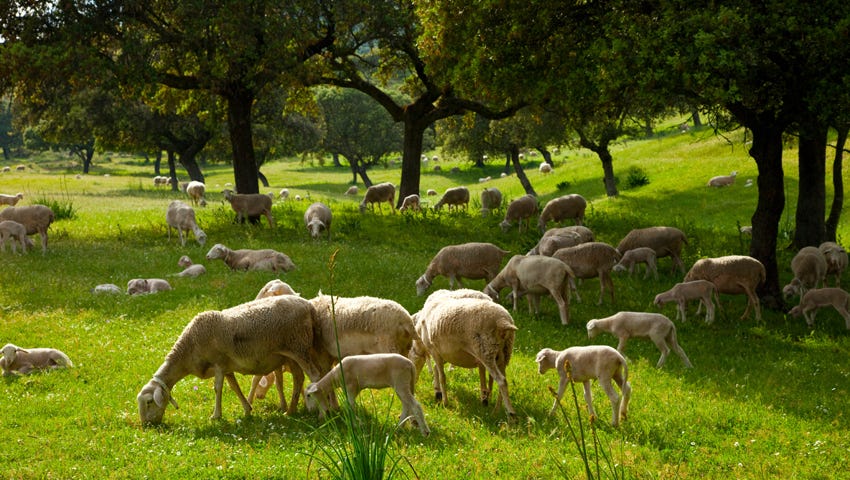
In southwest Spain, a collaboration with sheep farmers in the dehesa ecosystem tested plant-based feed additives — a blend of essential oils including thyme, oregano, citrus and flavonoids — as alternatives to chemical treatment for coccidiosis, one of the most persistent health challenges in those systems.
Across two consecutive lambing periods, with some farms used as untreated controls and others testing either conventional chemicals or the plant-based alternatives, the results were consistent: well-managed farms using the natural additives could effectively reduce coccidiosis incidence without chemical inputs.
“The best way to show the results was when the neighbour farmers could see when it was working and when it was not working so well,” Yáñez-Ruiz says. The independence of the research — funded without industry involvement in the results — added credibility.
With goats in southeast Spain, the research turned to animal welfare under heat stress — an increasingly pressing concern as intensification has pushed more of the sector towards year-round indoor production.
Working with farmers, vets, technicians and digital monitoring companies, Yáñez-Ruiz’s team fitted dairy goats with accelerometer collars, tracking behaviour — standing, moving, eating, drinking, ruminating — across summer lactations in consecutive years.
The collars, widely used in dairy cattle but still under development for small ruminants, enabled the team to link milk production, blood parameters and environmental conditions with individual animal behaviour. Crucially, they also revealed substantial variation in how individual animals responded to heat stress — variation linked to genetic factors. The longer-term ambition is to incorporate heat tolerance into breeding values, so that selection can account for an animal’s capacity to cope with the extreme temperatures that are becoming more frequent across southern Europe.
Both sets of research underline Yáñez-Ruiz’s broader point about farmer involvement: “When they are involved right from the beginning, they take ownership, and then there are more chances of success. When farmers tell their neighbours something works and explain how it works, that’s when you can spread the innovation — not just from the top.”
Regionalisation: opportunity or threat?
One theme that emerges in discussion of Feed No Food and pasture-based systems is the infrastructure question — specifically, whether regional processing capacity exists to support more localised supply chains. A previous Pathways episode had raised the possibility that regionalising value chains could reduce employment, as large abattoirs were replaced by smaller facilities.
Hall pushes back on the framing. “From Pasture for Life’s perspective, regionalisation has clear benefits: reconnecting production and consumption, shortening supply chains, retaining more value within rural communities. But I think we also need to avoid romanticising it.”
Large processing infrastructure exists because it delivers economies of scale, she acknowledges. Replacing a single large abattoir with several smaller facilities may increase costs — and opens the question of who bears them. But for farmers in the position of the Hall family, operating a small-scale system in the North York Moors, the calculus is different. “When regions lose that local processing infrastructure, farms become dependent on a small number of very large operations. That may be economically efficient for the wider food chain, but I don’t think it can be argued as beneficial for the animals, the farmers or the local economy.”
What comes next?
Pathways is drawing to a close, but the research relationships it has generated are continuing. Hall describes ongoing collaboration with European partners on resilient livestock systems, UK grassland projects and the Adopt trials — farmer-designed experiments supported by Pasture for Life. “Our role in the research team is to help turn farmers’ experiences into evidence, and take that evidence into projects like Pathways. We’ll continue to do that.”
Yáñez-Ruiz is direct about the lesson he takes from five years of working at the farm-research interface. “Working with farmers in this kind of research is essential. It’s not an option if we really want to get somewhere. Things need to be tested in the real world. And the only way we can improve our systems is by facilitating adoption of innovations that are co-designed and co-developed with farmers.”
Moakes, meanwhile, reflects on what the project’s multi-indicator approach has demonstrated: that no single metric can capture the full performance of a farm system, and that efficiency — real efficiency, across the full breadth of outcomes that farming produces — is ultimately a social and political question, not a scientific one. Pathways has tried to generate the evidence without prejudging the answer.
“We don’t say which one is better,” he says. “There are trade-offs. There are pros and cons for each approach. The idea was to give policy makers, farmers and the public a perspective — not to tell them what to decide.”
This article is based on the Farm Gate podcast episode on ruminant pathways in the EU Horizon 2020 Pathways project. The project has been running since 2021. Further episodes exploring specific aspects of the research — including biodiversity, scenarios and farm animal welfare — are available on the Farm Gate podcast channel.